Thursday, October 16, 2008

The Awful Truth about Preference Engines

Jayson Jarmon President,
The Lux Group, Inc.

When you encounter an online preference engine or recommendation system in your daily Internet travels, you may be inclined to scoff, “There’s no way the splendid complexity of my rich, multifaceted personality can be parsed by this generic demographic profiling software.” This is of course in some measure true: how can we say we truly know anyone? How can we hope to ever have a complete understanding of ourselves and others without veering into the philosophic or the metaphysical. Human personalities are a complex pastiche of biology and experience…so much like snowflakes, we are told, that no two are alike.

Enter the preference engine. You know the kind--Amazon.com’s book recommendation system… the ITunes “Genius” system, et al. Engines like these and hundreds of others casually suggest product choices to you based on the preferences and buying habits of others who have chosen this or that product in the past. As the user makes more and more choices, the system hones its recommendations until its insight seems downright eerie in its predictive abilities.

Let’s take William Shatner, for instance. While proudly hovering over my extensive collection of Shatner mp3’s in Itunes the other day (I believe my cursor was on Shatner’s stirring spoken word version of the Beatles’ “Lucy in the Sky with Diamonds”), the ITunes preference engine leapt into action and presented me with the following recommendations:
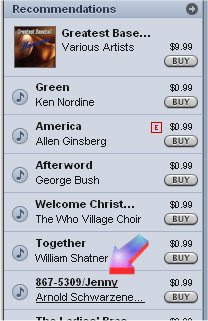


Yes – it’s a version of Tommy TuTone’s 1980’s hit “Jenny (867-5309)” as rendered by bodybuilder/actor/governor Arnold Schwarzenegger.

I was staggered. How could this simple online system deduce from the millions of needs that I might have at that particular time, that I absolutely had to have Arnold singing “867-5309” more than anything else in the world? More than food, more than drink…it was more than a mere physical need: the recommendation would fill the Arnold Schwarzenegger/Tommy TuTuone sized hole in my heart!

An insipid shelf-clearing scheme writ large on the Internet? A crass marketing tool designed to separate the suggestible from their money? A brilliant piece of software that simply reminds us that we are indeed part of a demographic, however obscure and pathetic? The preference engine is all these things, and, ultimately, a mirror into our very souls. Now leave me alone so I can get back to downloading the “Battlestar Gallactica” outtakes that I need so badly right now that it hurts.

Tuesday, October 14, 2008

Clear Design: Icons, part two
by Ben Thompson
Creative Director/VP, The Lux Group

Although the icon is capable of doing a great deal of heavy lifting in an interface, the more complex the action or concept it represents is, the less effective it becomes. Moreover, the designer’s skill in representing and rendering the concept also affects its usefulness.

Let’s use the ‘delete’ function as an example. If your ‘delete’ icon is a button with a big, clear ‘X’ on it, it will work as an excellent indicator of what will happen if you hit that button. Using the program or the website becomes easy—just look for the big ‘X’ to delete a file. Binary concepts like stop and go tend to be the easiest to illustrate, and by extension, the most intuitive to use.

Now say that you work as a designer for the company across the road that makes a competing interface. One spec requirement is a ‘delete’ button, and what could be clearer than a big ‘X’? Nothing, except that your competitor’s product already has a big ‘X’. Moreover, perhaps someone on the marketing team thinks that an ‘X’ is too negative, and suggests a wastebasket. Wastebasket renderings follow…

Icon design is one of those things (like logo design) that look easy, but which challenges the illustration and technical skills of even the best designers. When an icon falls short of indicating its function to the user, it decreases the effectiveness and functionality of the interface. The problem is that with a generation of users who have grown up with GUIs, many people assume that their project needs icon-based controls, rather than a simple and easy to use text-based solution.

Back to our wastebasket—after going through rounds of design revisions (What kind of wastebasket? Wire? Does that look too much like a bucket? What does a bucket mean to the user?) the team has decided that a tiny picture of a wastebasket is not clear enough, and that it will be more clear if a little ‘X’ is included in the corner. Each step that’s been taken from the easily recognizable and easily understood has made it more difficult for the end user to use the interface.

Here’s the upshot—when you depart from words into the realm of concept, you run the risk of compromising clarity. When you’re working with your web designer (or designers, when you’re working with your clients) it’s always worth a moment to ask the stakeholders why an illustrative icon is being used, rather than plain language. In the absence of issues involving translation into other languages, the most effective user design solution can be good old legible text.

As someone who’s spent time art directing designers working on creating a simple icon illustration for a complex concept like “litigation,” I can confidently say that sometimes the client’s design money is better spent elsewhere, and it’s the job of a good web agency to make that known early on in a project.

Tuesday, September 23, 2008

Clear Design: Icons, part one.
by Ben Thompson
Creative Director/VP, The Lux Group

The birth of the graphical user interface (GUI) also spawned the graphic icon. The ground-breaking move away from text-based systems was one of the prime differentiators between the Macintosh operating system and those that had come before it. The next year, Microsoft Windows 1.0 released, followed quickly by Word for Windows 1.0, and there was no looking back to text-based computing.

Icons at that time were 32 pixels square, rendered in no more than the sixteen system colors (when available), and these little darlings made the difference between a drab, workaday interface, and a more inviting, more intuitive work environment. My first icon project was in 1992, while working for Microsoft. The first version of the Microsoft Windows Sound System was being released with a bundled package of sounds, each of which needed a distinctive icon. I had fun putting together the tiny images in flat or isometric perspective showing bells, chimes, saws, and other noisy things. I am compelled to confess that with sixteen years and hundreds of design projects in between me and those icons, my memory has faded, and I’m not clear on what all of them were intended to represent—the jackhammer is clear enough, but the smartly rendered foot coming down on a banana peel is mysterious to me. I’m hoping it was a slide whistle.

Over the years, operating systems, hardware, and information graphics became more sophisticated. Better designers than I am devoted hours to telling stories or giving direction in those 32x32 pixel squares. With each version of the Mac or Windows operating system (with contributions here and there from outliers like NeXTor OS2) the art of the icon got more sophisticated. Then in November 1993, a funny thing happened.

For designers like myself who were internet-savvy (and up until then, that meant working with text-based USENET applications like Telnet, or FTP protocols for transferring files) and who’d worked on multimedia projects for proprietary systems up until then, the ability of a designer to present graphics on the Web opened a world of possibility for online design. Although the neutral gray background was a drawback at first, and the necessity for having text left justified (the ‘center’ tag was a year or two out at that time) was a limitation, a designer could put artwork up, have control over headline fonts, and offer interactivity with a relatively simple bit of coding.
Of course there were other limitations: in 1994, everybody looked at the web through phone line modems of varying slowness. Worse for designers, there were still a lot of really lousy monitors around. Around that time, I remember going in to talk to someone about some freelance work and seeing my online portfolio up on a sixteen-color monitor. All of the lovely continuous-tone scans that I’d included had dithered into the sixteen system colors. Horrifying.

Fortunately, that state of affairs didn’t last long. Paragraph justification options, background colors and photos, frames, tables, streaming media, and cascading style sheets were soon to come, and the graphic web environment has just gotten richer and richer. There’s still one thing that connects contemporary Web design projects to the earliest days of computer interface graphics: the icon.

Part Two to follow…

Monday, September 15, 2008

Lux Pitches in to Prevent Doomsday

Jayson Jarmon
President, The Lux Group, Inc.
As one of the most innovative Internet Development companies in the region, Lux prides itself on finding common sense solutions for its clients. In light of recent developments regarding the creation of microscopic blackholes by the Large Hadron Collider, Lux has taken steps to prevent its employees and contractors from taking similarly threatening actions.

As of today, Lux employees are prohibited from breaking the laws of thermodynamics in the office. Please see notice below, posted in the Lux facility. We hope other businesses follow our example and help keep the solar system safe!


Wednesday, September 10, 2008

BANG! Just kidding.


We at Lux congratulate the scientists from the CERN Particle Physics center in Europe for successfully erecting the Large Hadron Collider. At a cost of ten billion dollars, the LHC represents the most expensive and most ambitious attempt that mankind has made to peer into the origins and mechanisms of the universe. Over the next few years, look forward to a series of barely-comprehensible, yet fascinating stories to be dumbed-down and reported to us as a human interest story by astonished-sounding local news anchors.
People being people, though, not everyone is happy about this new peek at the fabric of reality. A contingent of The Concerned has become more and more vocal, insisting that this will lead to the end of the world. The naysayers are an interesting mix of folks—the usual handful of contrarian scientists who gather a bit of the spotlight by providing ‘opposing viewpoints,’ has been amplified by the Easily Scared…the same folks who have basements full of eight year old MREs left over from when the world ended on January 1, 2000.
Mix those folks in with the anti-science contingent (I’m talking to YOU, Kansas, and to YOU, Florida) and you get a vocal bunch of torch-bearing villagers who are up in arms about the “European Time Machine” and its attempts to unravel the mysteries of the Big Bang.
Will The Concerned and the Easily Scared stop the Large Hadron Collider? It’s doubtful. Are they right that it could spell the end of the universe (as we know it)? Also doubtful. Just in case, though, It’s probably a good idea to check in from time to time with a fantastically useful site, “Has the Large Hadron Collider Destroyed the World Yet?

Ben Thompson 9.10.08

Thursday, May 8, 2008

Practical Information Architecture on the English Model

Jayson Jarmon
President, The Lux Group, Inc.

When one needs to move millions of workers each day through a complex system of underground tunnels and train stations, information management, signage, and practical design are essential to prevent chaos and confusion. The well-known map of the London Underground transport system is an iconic touch point in brilliant, usable design. Regardless of language, level of experience, or familiarity with public transport, millions upon millions of users of the London underground can instantly understand and follow the maps, getting where they need to go even if they are relatively unfamiliar with the city and outlying suburbs.

When Microsoft asked Lux to design a poster for the Office System Developer's Conference 2008...one that had 7 different tracks variously intersecting 82 different course modules, well we borrowed an old time-honored model from the London Underground:


Microsoft Office System Developer's Conference 2008 Tube Map

Saturday, May 3, 2008

An Honest-to-Goodness Waterloo Sunset

Jayson Jarmon
President, The Lux Group, Inc.

Not Your Great, Great, Great-Grandfather's London

Jayson Jarmon
President, The Lux Group, Inc.

While visiting old friends at Think London (London’s official foreign direct investment agency), we had an opportunity to talk about the Capital’s economic growth and prospects, the rapidly approaching 2012 Olympic games, and the transformation of London itself as it progresses further into the 21st Century.

Think London has updated its HQ since we last met and have moved into London’s Canary Wharf area. To those who don’t know London, it’s a vast organic place with few buildings over 10 stories—the city grew over the centuries along ancient roads and byways. Canary Wharf, built east of the city in abandoned docklands in the late nineties, seems more like an American city with enormous skyscrapers and even a grid-based street system.


A Canary Wharf Skyscraper

Think London has a beautiful view up the Thames to the west, and you can see the cataracts of the river all the way to Westminster.

Here we see Lux Creative Director Ben Thompson enjoying the view:


Who let this guy in?

Thursday, May 1, 2008

I Sing the Body Electric

Jayson Jarmon
President, The Lux Group, Inc.

Elsewhere on this blog I have made the case that “everything that can be digital, will digital”—perhaps this is even true of automobiles (well, if not digital, then electric at least). In the US, we pat ourselves on our backs over our hybrids and think we’re all that. In London tonight I saw some real thought leadership. Across from the Lyceum Theater near the Waterloo Bridge, I saw my first electric car at an “electrobay recharging site.” What appears at first to be a parking meter, is actually a plug and extension cord for recharging electric vehicles.


Hybrid? Schymbrid!


Clean, precise, efficient work with a nod to futurism in that little green light. Sounds like the essence of London design to me.

Tuesday, April 29, 2008

Blog-Archy in the UK

Jayson Jarmon
President, The Lux Group, Inc.


See, they even named a street after me!

13 years is a long time, and in Internet years it's a really long time. We've worked with multiple partners in the UK since 1995 when I was the original project manager for the BP corporate site, and I dearly love getting the opportunity to touch base in a city that is arguable darker and rainier than Seattle (somebody will have to consult Wikipedia on that). So, whenever we're in London it's fun to get a sense of what's going on in the design and development world (and the pub world, but that's an entirely different story).

So, this week Lux Creative Director Ben Thompson and I are off to the UK once again talking to folks about interactive development projects, and we'll be blogging from London and its environs on an irregular basis. We'll post photos, talk to designers, and see what's hot in London during the rainy month of May. Who knows, we may even get a glimpse of Ben's band onstage in Soho.

Monday, March 24, 2008

Nerd Alert!

Are you fond of retro-futurism? Each generation envisions the future a little differently than its predecessor. Jules Verne foresaw spaceships to the moon, Arthur C. Clarke imagined communion with higher intelligences. Even Hanna -Barbera envisioned a world of space needles and robots called The Jetsons. In time, these predictive fantasies are overtaken by history, encased in amber like the mosquitoes in Jurassic Park. They seem quaint.


Whole Lotta Rosie

The science fiction of each generation says more about contemporary thinking than any real future of course. Fritz Lang's Metropolis was more about class warfare and anxiety over the rise of fascism than it was about the distant future...the double-feature space monster movies of the 50's were always more about Cold War anxieties than the giant ants...don't even get me started about Starship Troopers.

As I was riding to work today on the retro-futuristic monorail, approaching the retro-futuristic Space Needle, I started thinking about computers and how predictive (or not) the sci-fi dreamers have been.

What does retro-futurism tell us about computers? Did anyone predict distributed computer networks, the World Wide Web, or the Internet? I don't think so -- generally, computers in science fiction come in three flavors:
  • Super Computers that Threaten our Liberty (Colossus: The Forbin Project, I Robot, Tron, The Matrix)

  • Defense Computers Run Amok that Threaten our Extinction (War Games, The Terminator)

  • Cold, Disembodied Intelligences Rivaling or Superior to Humans (2001: a Space Odyssey, Hitchhiker’s Guide to the Galaxy)

I cannot think of a single piece of science fiction that predicted microcomputers, distributed computing, or the digital revolution. Perhaps that's because the digital revolution is so unique and democratizing, that it failed to elicit the angst of the apocalyptic sci-fi visionaries.

So let this stand as a challenge: if you know of any well-known retro-futurist or science fiction writer who predicted the Internet please send me a mail that I might stand corrected.

jaysonj@luxworldwide.com

Thursday, November 1, 2007

Microsoft Silverlight: Lux Worldwide is leading the way

Jayson Jarmon
CEO, Lux Worldwide

New web application development technologies appear (and disappear) everyday, but very few come out of the gates as strongly as Microsoft’s new cross-browser, cross-platform rich-media delivery platform, Microsoft Silverlight. As web applications become increasingly media experiences as opposed to simple text content and navigation, a platform that is .NET-based while still flexible enough to support AJAX, VB, C#, and Ruby is a valuable tool for internet developer’s like Lux.

We used the technology recently to create the Microsoft Office Interactive Developer Map: a tool to help developers to navigate that sea of technical content, to access the information they need quickly, and to see the depth and extent of the content available to them at a glance. The application that represents a synthesis of much that is new at Microsoft, but not just in its content: Lux built the application using the Silverlight platform and the Expression Blend development tool.

Lux Worldwide is a leader in Microsoft Silverlight development and design. It’s a platform you should consider for your next interactive application project.

Jayson

Friday, October 5, 2007

IKEA Comes To Lux

By Jayson Jarmon, President and CEO, Lux Worldwide

IKEA-inspired chaos in the alley – please send Starbucks!

There is a great commotion this morning in Post Alley beneath the lofty Lux Towers: video production companies with caterers, klieg lights, gaffers, grips, and gawkers – the whole nine yards – are filming a commercial for IKEA. Actors are coming and going, cars and packages are strewn about the street; a whole comic uproar is taking place. It’s becoming increasingly obvious that the production has come between ourselves and our Starbucks, and that there seems to be no immediate resolution to affairs cinématographique … one begins to feel trapped. So this blog stands as an interactive SOS – if anyone out there is reading this, please send coffee.

Jayson

Wednesday, September 12, 2007

Blacklist Patrol

By Loren Skaggs, Vice President, Marketing and Business Development, Lux Worldwide

I’d like to give a shout out to our IT Director, Rich Olson, who, in his apparently ample spare time, manages his own product line, particularly the popular anti-spam product SpamButcher.

Rich has just released a new product, and it looks like a winner: Blacklist Patrol. This product is designed for one very narrow, but very important purpose – it is designed to prevent you from ending up on an anti-spam blacklist.

If you’ve never had your domain blacklisted, then you may not realize the value of this product, but trust me – it could save you a lot of grief.

Here’s what happens: Many companies find their email servers listed on anti-spam blacklists even though they would never intentionally send spam. As a result, mail they send may never make it to the intended recipient. Often the problem is that either their server or one or more of their desktop systems has been compromised by spammers, and actually is sending spam.

Blacklist Patrol helps to address this problem by monitoring major blacklists to see if the your server is listed. Once the you discover that you have a problem, you can take action to get yourself removed from the blacklist.

Like I said, the solution is very narrowly targeted, but then, in my experience, the best solutions usually are.

Good luck with Blacklist Patrol, Rich!

Loren

Thursday, August 30, 2007

Uniformity

By Jay Jarmon, CEO, Lux Worldwide

Everyone has a uniform of some kind, I suspect, but software people have eschewed the formality of business fashion since the days of short-sleeved white shirts, clip-on ties, Buddy Holly glasses and IBM.


During my formative years at Microsoft, the only people caught dead in suits and/or ties, were interviewees who were unfamiliar with the lax dress code. On the second day of interviewing, they would always return in what has come to be known as “business casual,” in an attempt to persuade the interviewers that they weren’t too stiff and formal for the company.


At my first company, Saltmine, things were even less formal. As a web development agency, we weren’t restrictive at all about appearance. The business casual of Microsoft looked positively glamorous in the early Internet culture… a patois of punk rock, gamer nerd, glue-sniffing geek, and how shall we say, things nebbish-ista.


I mean, take a look at this guy:


He’s my business partner, for cryin’ out loud!!

So now days, the Internet business is reaching a kind of maturity (although I agree it’s iffy to use “Internet” and “Maturity” in the same sentence). With this, ahem, maturity, there has come a ubiquity of clothing unseen since the days of IBM. I’m talking about the omnipresent BLUE SHIRT. As I cast my eyes down 1st Avenue here in Seattle, I can see blue shirts on every block, at every Starbucks, and in the lobby of every building I pass. Why blue? Why now?


So in the beginning was the end, the software fashion cycle has come full circle from conventional to unconventional and back again. As for me, I have a blue shirt and a Rat City Roller Girls T-shirt so I feel prepared for just about anything.

Wednesday, August 22, 2007

Fear Not the Metal Ones

By Loren Skaggs, Vice President, Marketing and Business Development, Lux Worldwide


A hot topic around our office water cooler the past week as been the recent New York Times article that puts forward the idea by Oxford University philosopher Nick Bostrom that we might all be living in a computer simulation. What’s fascinating about the concept is not that it just might be possible, but that – if Bostrom’s calculations are correct – it is actually probable that we’re living in some sort of a simulation.

The logic goes like this: you calculate the likelihood that we will eventually develop a computer simulation that is sufficiently complex as to develop self-awareness. If the likelihood is high, as Bostrom estimates that it is, then the likelihood increases that such a simulation has already been created by someone else, and that we are living within that simulation.

My ramblings can’t do this concept justice. Just read the article.

Now, some people might find this disturbing, but I’m not going to start worrying about it. After all, if we ARE in some elaborate computer simulation, there’s no way we’d be able to find out for sure, and nothing practical we could do with the information if we had it. So, relax.

Besides, from long experience in working with start-ups who have had as their goal creating simulated environments, there’s one thing I’ve learned with great certainty: creating simulated environments is hard. It’s one thing to create a computer that can beat you at chess; it’s quite another to create one that will decide on its own that it prefers to play Madden 08.

This unease about the immediate future of technology is nothing new. Science and technology reporting, as well as science fiction, is rife with stories of technological nightmares that lie just around the corner. In the earlier parts of the 20th century, there were dire warnings about the robots, the mechanical men who would rise up and destroy us all.


Westinghouse's H. J. Wensley and his mechanical man, "Mr. Televox" in 1928

In the latter parts of the century it was fear of the run amok computer, in films such as 2001: A Space Odyssey and Colossus: The Forbin Project. By the 1980s, the robots and computers had joined forces to rid the world of humanity in films like The Terminator. We always seem
to be one step away from having our tools take over for us altogether.

But it never happens.

Why? It’s because the nightmare we can imagine is a nightmare that’s already under our technological control. If we can build a killer robot, we can build an appropriate fail-safe. This doesn’t mean that things can’t go horribly wrong – they can and they do. It just means that, for now, the likelihood of our machines becoming more sophisticated than us is very, very
unlikely.

Until The Singularity comes, that is. Then all bets are off.

Run for your lives!!!

Loren

Friday, August 10, 2007

A Piece of the Action

By Loren Skaggs, Vice President, Marketing and Business Development, Lux Worldwide

I get asked by clients, more often than you’d think, “Would you like to have a piece of our company rather than payment in cash?”

This was a lot more common back in the heady days before the burst of the dot-com bubble, but my answer now remains the same as it was then: thanks, but no thanks.

It’s not a reflection on the quality of the companies we’re dealing with – it’s just a question of the nature of the relationship. A good website design and development agency should be a trusted partner to help you create and maintain a high quality presence online. It should not be in the position of banker or backer or silent partner. An agency committed in this fashion can quickly lose focus. A good agency should be paid in cash – and should be worth every penny you pay.

I can’t say, however, that I haven’t been tempted to take a cut instead of money. And herein lies the value of experience. For example:

Back in 1998, we were approached by a company called “Ioptics,” which had developed a revolutionary storage product called “OROM,” or Optical Read-Only Memory. This company had everything going for it, or so it seemed. The technology had been developed by the inventor of the Compact Disc. The company had funding from Microsoft. And they had a smooth marketing department, with a well respected and likeable marketing director, who walked around with a very cool mock-up of an OROM device in his pants pocket. The press was ga-ga for the thing. People were predicting the death of everything from the Zip Drive to the CD at the hands of OROM devices.

Original Ioptics imagining of the OROM device.


It will sound stupid nowadays, living as we do with 2GB Flash memory drives available for $39.99 at any drug store, but back then, a pocket sized device with no moving parts and capable of storing a whopping 128MB (!) was nothing short of science fiction. It seemed like a can’t-lose proposition. We had many hushed conversations in our offices about whether or not this was a company we should consider taking a piece of in lieu of payment. However, we went against what we thought was our better judgment, and decided to stick to policy, and do our design and development work for a strictly cash arrangement.

Lucky us.

Within a year, the OROM product had been rendered obsolete by new advances in storage technology. And with OROM the only arrow in their quiver, Ioptics quietly shut its doors. Now, there is nary a trace of its existence online – even the ioptics.com website was sold off. It could easily have taken us down with it.

OROM was supposed to have worked kind of like this, sort of.


Ioptics was not a bad company, and the people who ran it weren’t stupid. The market just got away from them before they were able to strike. And that was nothing that could have been predicted, certainly not by us, anyway.

So, lesson learned: if your work has value, your clients will be willing to pay for it. It’s a formula as old as business itself, and it’s a model that is worth following.

Do the work you do, the best you can do it. This will free up your clients to do whatever it is that they do, the best that they can do it.

What’s so crazy ‘bout that?

Loren

Monday, August 6, 2007

The Art of Hyperbole: RIP, Weekly World News

By Loren Skaggs, Vice President, Marketing and Business Development, Lux Worldwide

When it comes to news, I’m generally a pretty serious individual. I read the top stories from most of the major newspapers on a fairly regular basis, a habit that goes back to my days as a journalist (although now, of course, I’m reading them online). However, I have long harbored a dark secret: I love – LOVE – the Weekly World News. In fact, if there was one dream job that I could have had (other than this one, of course!), it would have been to be a writer for the WWN. Heck, I’d have been happy just to write those headlines!

Alas, it appears this dream is not to come true. American Media, the parent company of the WWN, has recently announced that it’s shutting down publication of the tabloid at the end of this month.

This is sad news indeed. While other tabloids, such as the Star and the National Enquirer, give lip service to oddball stories, the WWN pulled out all the stops. Not only did they never let the truth get in the way of a good story, they never even considered doing so. Whether it was an Elvis sighting, an alien presidential endorsement, or a romance with Bigfoot, the WWN shamelessly invented stories that struck a universal chord and tugged at our psyches.

They were the professional wrestling of the publishing world.

So, what does this have to do with online marketing?

Well, I’m tempted to say “nothing,” and just claim that I wanted to use the pending closure as an excuse to wax nostalgic about my favorite supermarket publication, but that simply wouldn’t be true. Here’s the takeaway from this:

Hyperbole sells. The WWN knew it, but they didn’t invent it. Any kid who ever bought a comic book off the shelf knows that the cover is always a little more scintillating than the actual contents. And this is something you can use in your marketing materials.

For instance, maybe all your company did last month was install a single set of accounting software licenses for a chain of grocery stores. You can write up a press release that says, “Our Company Sold Some More Accounting Software Licences.”

Or, you can say, “Our Company Helps Our Client Bring in the Cabbage!!!” It’s more direct, it’s more engaging, and it’ll encourage visitors to your site to read a little more.

I keep the WWN approach to headline writing in mind whenever I’m preparing marketing materials, so it’s truly sad to see this paragon on BS disappear from store shelves.

And yet, on August 27, the Weekly World News will be no more.

Or, will it?

I’ve heard from a reliable source the Weekly World News has been spotted at a Burger King just outside of Lexington, Kentucky, enjoying a Double Whopper and Fries. It’s totally true!!!

‘Til next time,

Loren

Wednesday, August 1, 2007

The 12 Kinds of Ads: Can You Make Them Work for You?

By Loren Skaggs, Vice President, Marketing and Business Development, Lux Worldwide

There are a few features online that I make a point to read regularly. One of these is Seth Stevenson's regular column in Slate Magazine called "Ad Report Card." Stevenson uses this column to assess the quality and effectiveness of current television ads. This is one of the few places outside of the trade press where you can get this kind of analysis, which I find a little puzzling, given the ubiquity of television advertising in our lives.

The most recent Ad Report Card column is very interesting, and warrants a read (or, rather, a look -- it's in the format of an online slide show). In the column, Stevenson explores ad-man Donald Gunn's 12 categories of advertising, or "12 Master Formats," as Gunn calls them. As Stevenson explains, Gunn developed the notion that there are really only 12 basic formats for television ads, and if you are familiar with the formats, it will make it easier for an ad creator to develop a new campaign.

Stevenson swallows the concept whole, which is fine, because it really is a useful way to analyze ads. However, it's arguable that Gunn's model may be missing a few types, or that some of them are difficult to distinguish. So be it; that topic may be fodder for future blog entries and for endless debate among us marketing types.

The question is: Do these categories apply to your online marketing efforts? Has the new media rendered Gunn’s ad types model to be moot? Probably not. I’ve tried to wrap my head around all 12 categories, and when I look at marketing-centric sites, I still see echoes of the 12 basic types.

So, if you’re looking to redesign your website and you’re a little stumped on where to begin with a messaging approach, you might want to consider the 12 types and try to figure out if employing one of them as a format will help you conceptualize the direction of your site.

More in future posts … stay tuned.

Cheers,
Loren

Friday, July 20, 2007

Rowling the Dice: Harry Potter and the Internet

By Jayson Jarmon, CEO, Lux Worldwide

It’s amusing, in a sad and cynical kind of way, how readily newspaper men have lapped up the stories of piracy surrounding today’s release of the final Harry Potter installment Harry Potter and the Deathly Hallows. Of course it’s possible that someone who had access to the book took individual photos of each page and published the entire thing on the Internet just to spoil the “surprise” ending of the story (by the way, if you want to know the ending prior to tonight’s midnight release, just read this Washington Post article and it will tell you exactly where to look.

The Potter Empire was certainly taking a risk trying to protect the “secret” ending of a book that’s a part of such an enormous franchise. In fact, isn’t it, well… predictable that it would be pirated and published in some way to the Web? And is it possible that like many recording artists who now “bootleg” their own material and then use it to market their releases, that feeding this information to the Internet on the very eve of the book’s publication is actually part of an Internet marketing campaign?

Is it cynical at all to believe that the 36-chapter conclusion to the Potter saga was deliberately released to the Internet audience immediately prior to the release of the book in order to whip up the “will Harry die?” marketing ploy that’s being used to sell the book? Do you really know any Harry Potter fans who will *not* buy the last book because it’s been pirated on the Internet? …Something that virtually anybody who buys the book can do tomorrow anyway?

Sure I’m cynical, but I get a little tired of the traditional media always labeling the Internet as a spoiler, or as being a vast network of pirates and thieves conspiring at all times to undermine their somehow-more-legitimate publishing efforts. In this case, I believe we are seeing the effects of a coordinated marketing campaign, not the dark magic of the Internet.